Contact Us Careers
Lung Cancer

I am still worried about lung cancer after surgery. What should I do?

时间:2026-04-22 人气:

If you can't understand the subsequent professional description, just take two minutes to read through this text.

Overview of the disease


In April 2020, Ms. Liu underwent a chest CT scan, which revealed a mixed-density nodule in the left upper lobe. Subsequent contrast-enhanced scans showed a solid component with mild enhancement, containing punctate and patchy gas density, closely associated with the adjacent interlobar fissure, suggesting a high likelihood of lung cancer. Upon discovering the lesion, Ms. Liu underwent thoracoscopic left upper lobe resection and lymph node dissection under general anesthesia at a local hospital. Postoperative pathology revealed invasive adenocarcinoma, closely adjacent to the lung membrane, involving the bronchioles, with no clear nerve invasion or intravascular cancer thrombus . No cancer metastasis was found in the surrounding lymph nodes (0/4 in the peribronchial region, 0/2 in group 5, 0/1 in group 7, 0/1 in group 9, 0/2 in group 10, and 0/3 in group 11). Postoperative staging was pT2aN0M0 Ib stage, and molecular pathology showed no mutations in KRAS and EGFR.
Department
Pu
Small
Knowledge
   

knowledge


CT Manifestations of Lung Cancer
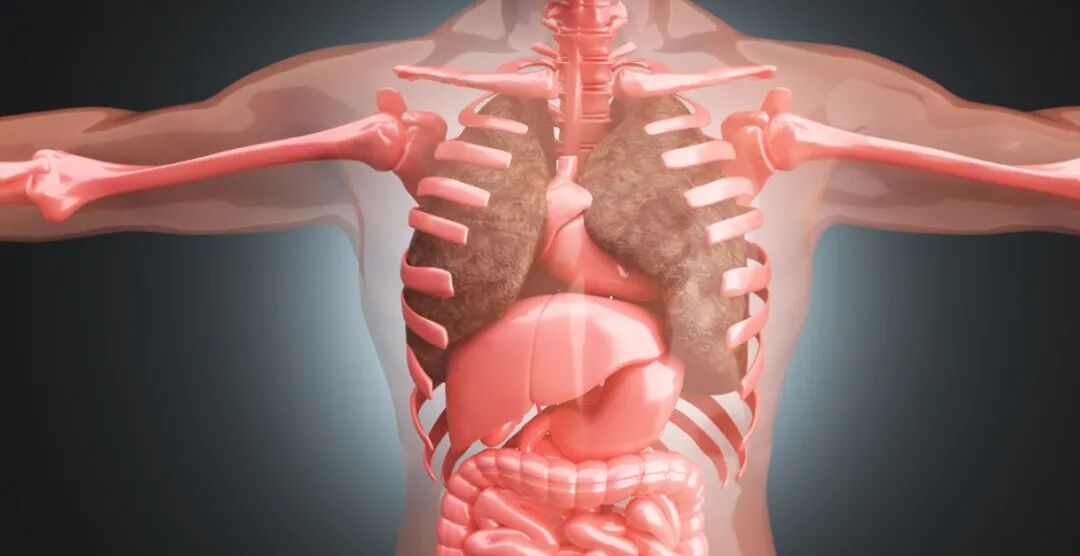
Mild enhancement on CT contrast-enhanced scan indicates that the blood circulation in this area is very rich, suggesting a possible malignant tumor. In addition to contrast-enhanced CT, in routine plain scans, if CT indicates irregular nodule morphology, peripheral spicules, blurred edges, or vascularization, it suggests a higher likelihood of malignancy and requires prompt radical surgery. Cancer cells proliferate and grow within the pulmonary lobules, stimulating proliferative stromal reactions in the interstitial tissue. The uneven growth rate of tumor cells in various directions, stromal reactions, atelectatic alveoli, and proliferative small blood vessels can lead to the appearance of spicules. Most nodules with lobulation and spicules are likely to be malignant.

After reviewing Ms. Liu's medical records, Professor Zhang Minghui made the following analysis and judgment:

1. The patient underwent radical surgery for early detection of the tumor through physical examination, and the postoperative staging was early (pT2aN0M0 Ib stage).

2. Although the radical surgery was performed and the staging was early, the tumor was close to the lung membrane and had already invaded the bronchus, making it prone to intra-pulmonary and pleural metastasis. The patient was very worried.

3. NKT therapy utilizes powerful immune cells to eliminate tumor cells that may remain undetected in the body, with essentially no side effects. Combined with NKT cell therapy after surgical treatment, it can effectively reduce the incidence of tumor recurrence.
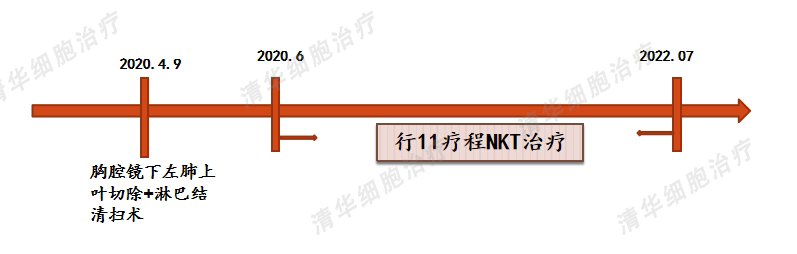
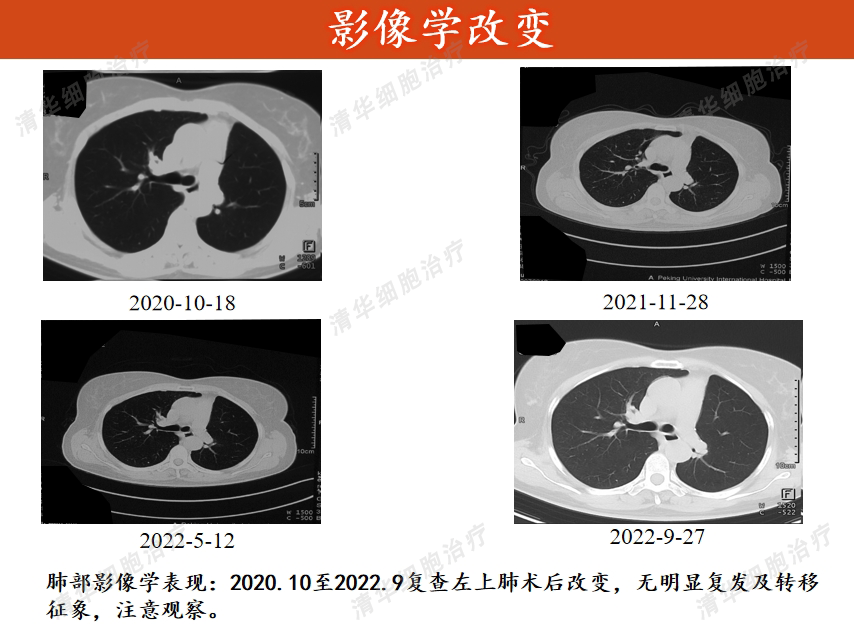
From June 2020 to July 2022, Ms. Liu completed 11 courses of treatment, and no clear signs of tumor recurrence were observed during multiple follow-up examinations, indicating overall stable disease.


Imaging

,  


Tumor markers

 
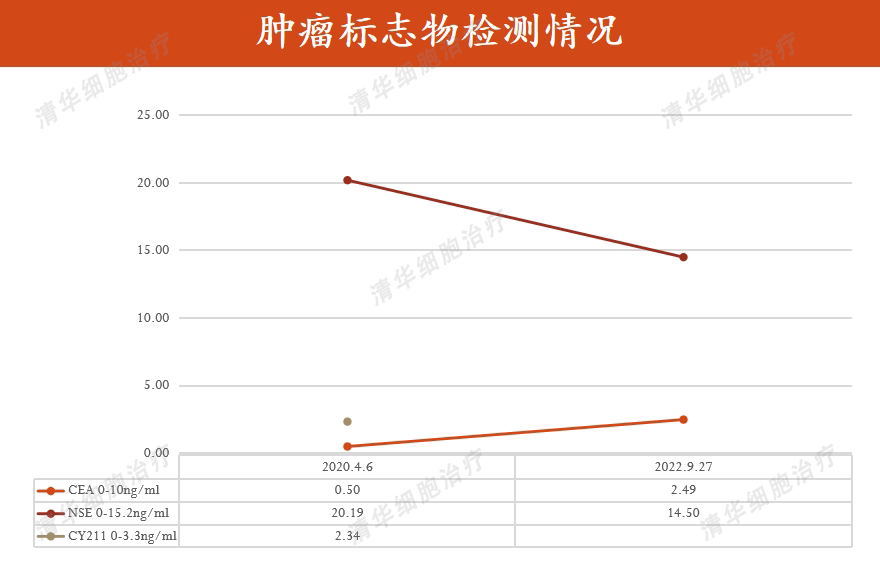
Tumor markers: The tumor marker test in April 2020 showed that NSE was slightly high, while the remaining indicators were normal. In September 2022, the NSE level had returned to within the normal range, and all other indicators were normal upon reexamination. Regular reexaminations are recommended.


 Conclusion and Comments


Ms. Liu's quality of life has been greatly improved. Her mental state is excellent, and she feels more energetic and vigorous when doing things, recovering to her pre-illness state. She leads a normal life and works without being affected by the disease. The latest quality of life score is 77.5 points.
Ms. Liu was very scared after discovering the tumor, and even after undergoing surgery, she was still worried about recurrence. During the two years of NKT cell therapy, her overall condition remained stable with no progression after multiple follow-ups.
The demographic data of lung cancer patients has changed over the past decade, with a decrease in smoking rates and earlier diagnosis stages. For patients with early-stage non-small cell lung cancer, the main treatment strategy is radical resection of the primary tumor, with a 5-year overall survival (OS) rate of 73-90%. However, some patients still face the risk of tumor recurrence and metastasis after surgery, resulting in a reduced survival rate after resection of the primary tumor.
There is still a certain risk of recurrence and metastasis after early-stage lung cancer surgery, and Ms. Liu was still very worried after the surgery. In order to achieve long-term stability, Ms. Liu chose NKT cell therapy. In this process, NKT cell immunotherapy plays an indispensable role in reducing the risk of recurrence and metastasis. It not only eliminates residual tumor cells but also strengthens the immune system, thereby providing patients with long-term stability.
Popular science knowledge is provided for reference only. Individual patients should seek clinical medical advice.   

References:

[1] Qian JY, Li ZX, Wu LL, Song SH, Li CW, Lin WK, Xu SQ, Li K, Xie D. A clinical risk model for assessing the survival of patients with stage IA-IIA non-small cell lung cancer after surgery. J Thorac Dis. 2022 Nov; 14(11):4285-4296. doi: 10.21037/jtd-22-890.
Classic NKT Case Review

Click on the image

to view