About Lehe
乐于心,和与众,与己乐,与人和; 心宽念纯,百病无生。


乐于心,和与众,与己乐,与人和; 心宽念纯,百病无生。

Cancer is not to be feared; it can be prevented and treated. The key lies in having the right mindset and scientific methods!
— Tsinghua University. Zhang Minghui
01
Case Analysis
If you can't understand the subsequent professional description
just read this text in two minutes
Many patients who have some understanding of cellular immunotherapy often ask the same question: How long does cellular immunotherapy need to be continued before treatment can be stopped? Is long-term maintenance necessary?
Actually, no. This is because immunotherapy has its unique "tail effect". However, of course, "stopping treatment" requires a premise—the patient's own immune system must be fully activated and restored to its previous immune state.
What is the "tail effect"?
In simple terms, it means that after a certain duration of immunotherapy, the good therapeutic effects from the early stage can last for a long time, without the need for drug maintenance, and without the concern of "drug resistance"—this is the biggest difference between immunotherapy and chemotherapy or targeted therapy.
Let's take a look at a case study of such a patient.
For many patients who have benefited from NKT treatment, they are reluctant to stop the treatment in their hearts. But due to the pandemic this year, Mr. Liu had to interrupt his NKT cell immunotherapy for five years.

Brief Introduction to Mr. Liu's Condition
Mr. Liu is a patient with gastric cancer.(To view Mr. Liu's previous cases, please click.)In January 2014, he underwent radical resection for cardiac cancer. Postoperative pathology revealed a moderately differentiated adenocarcinoma (cardiac) with ulceration, 2/12 lymph nodes around the cardiac region, and Lauren classification as intestinal type. The staging was pT4aN1M0 stage ⅢA. After surgery, he received 4 cycles of XELOX chemotherapy, but due to significant side effects, he switched to oral single-agent capecitabine chemotherapy for 4 cycles.
Mr. Liu's disease stage is advanced, and there is lymph node metastasis, posing a high risk of recurrence and metastasis. Therefore, after the completion of adjuvant therapy (September 2014), NKT cell therapy was chosen for prevention as the main objective.
At the same time, the patient did not have any tumor burden, so the treatment frequency did not need to be very high, with one course of treatment every 3 months. By the end of 2019, he had completed 20 courses of NKT cell immunotherapy, with a disease progression-free period of up to 62 months (over five years).
However, due to the pandemic in 2020, Mr. Liu's NKT cell infusion was forced to be suspended. Previously, he was very worried and anxious about whether the interrupted treatment would lead to tumor cell reactivation.
Of course, the situation of each patient is different, so the duration of continuous immune cell therapy is also different. Moreover, due to the slow onset of cellular immunotherapy, a continuous treatment period of 2 to 3 years is required , and the treatment frequency can be appropriately adjusted according to the specific condition.
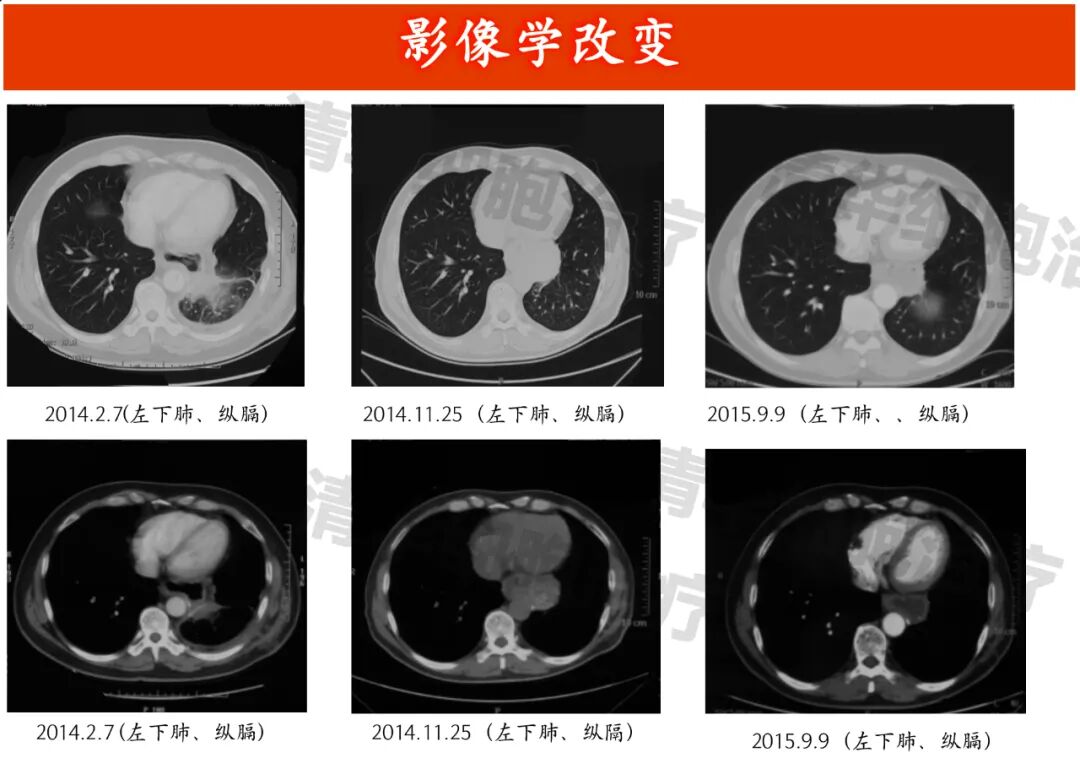
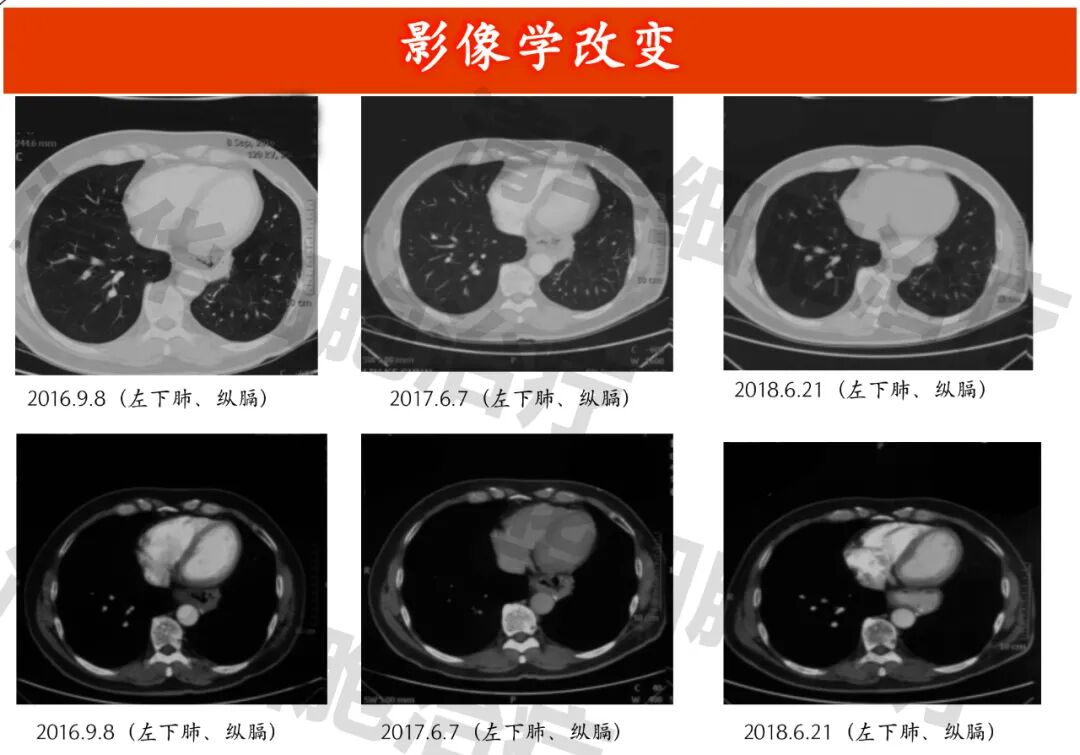
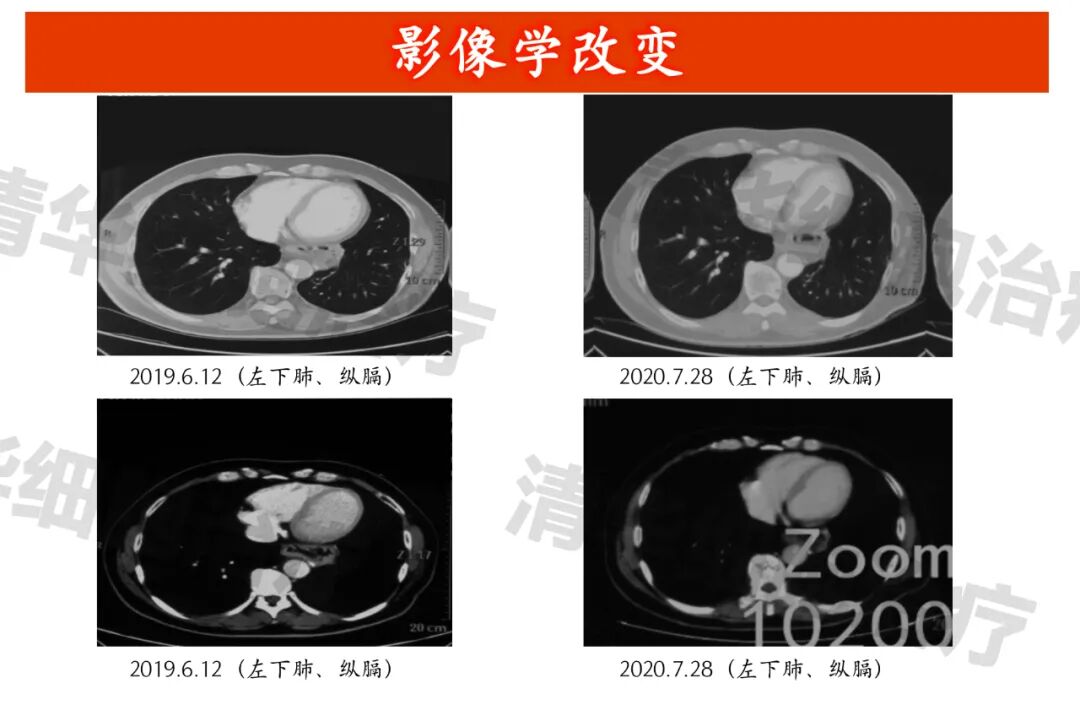
After a year of anxiety, the latest review results showed that Mr. Liu's imaging and blood test reports remained stable, with no signs of recurrence or metastasis, and he continued to maintain a good quality of life.
02
Treatment Overview
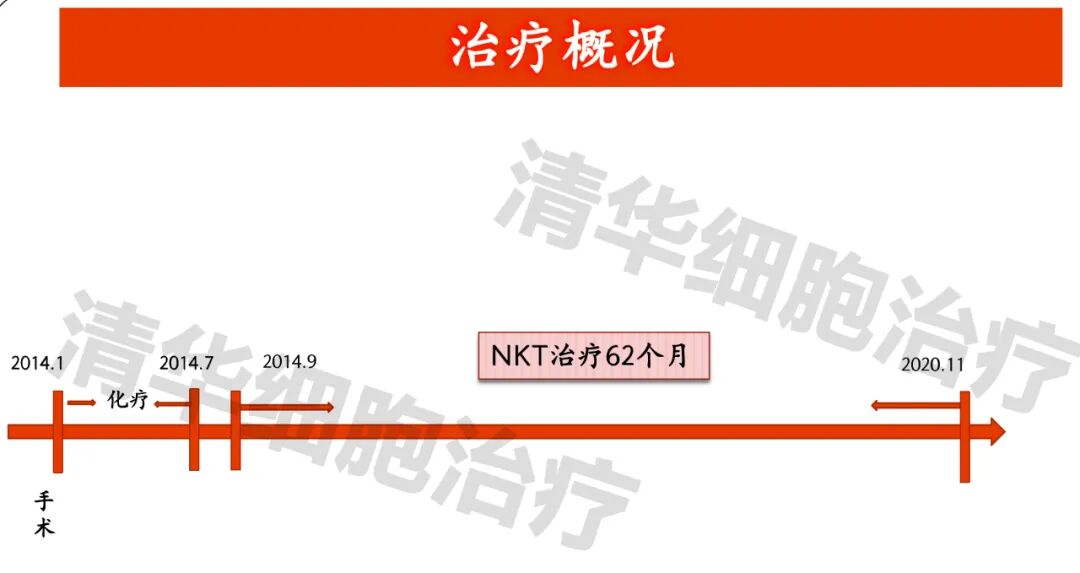
Treatment Overview of Mr. Liu
In November 2013
the patientexperienced upper abdominal pain without any apparent cause.
On December 31, 2013
a local hospital performed a gastroscopy, which revealed a space-occupying lesion in the gastric cardia and fundus, and the biopsy indicated adenocarcinoma.
On January 7, 2014
at Qilu Hospital of Shandong University, a radical resection of gastric cardia cancer was performed under general anesthesia through a left thoracotomy. The postoperative pathology indicated: (Gastric cardia) moderately differentiated adenocarcinoma, ulcerative type, tumor size 2.5cm x 0.7cm, invaded through the serosa, resection margin (-), pericardial lymph nodes 2/12.UGT1A1* wild-type*28 mutant type, HER-2(-), Lauren classification.
On January 12, 2014, the patient commenced a 4-cycle XELOX chemotherapy regimen due to significant weight loss and weak constitution.
On May 8, 2014, the regimen was switched to a 4-cycle oral single-agent capecitabine chemotherapy, with the last cycle completed on July 29, 2014.
Since September 2014, the patient has undergone NKT cell therapy, with a regimen of one course every two months. To date (October 2020), 21 courses have been completed.
NKT cell immunotherapy was adopted, initially with a regimen of 4+4, later changed to 6 courses per year. To date, 32 courses have been completed (as of October 2020).
03
Imaging data
04
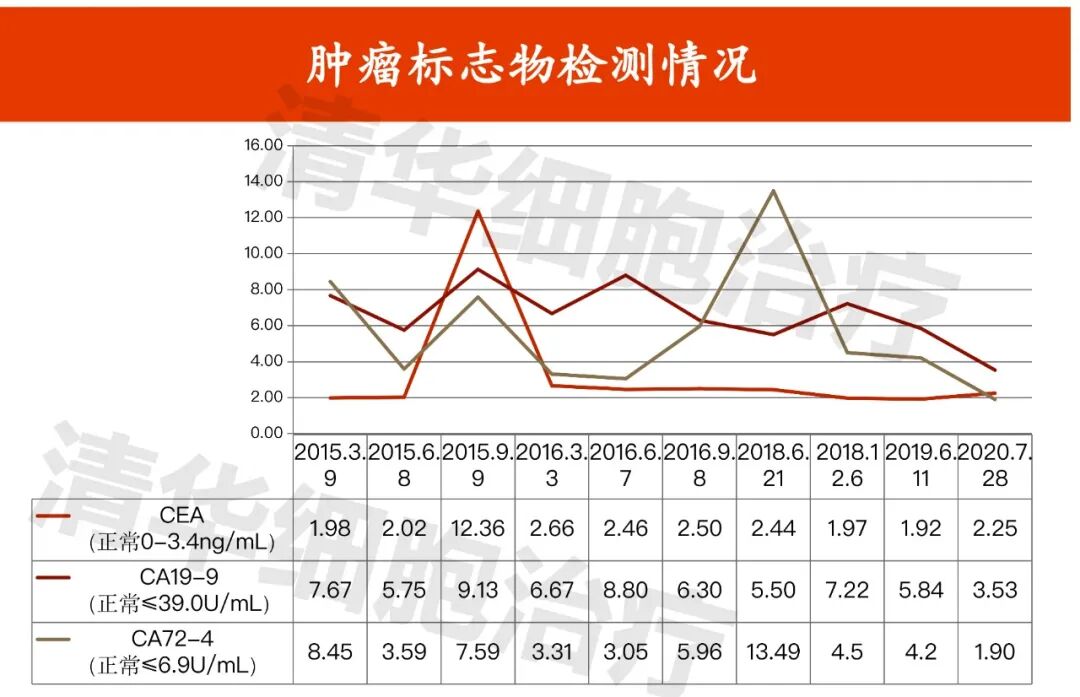
Tumor Markers
Click on the image
to view


Popular science is a form of charity
<<<Long press to scan QR code
Follow Tsinghua Cell Therapy

Address: Room 1101 (Unit 101), 11th Floor, Building 1, No. 7 Courtyard, Kexueyuan Road, Life Science Park, Changping District, Beijing
Phone:010-8265 9866
Email:lehemedneo@hotmail.com