Contact Us Careers
Other Solid Tumors

Prioritizing immunotherapy makes advanced renal cancer with brain metastasis less terrifying

时间:2026-04-27 人气:

Cancer is not terrible; it can be prevented and treated. The key lies in having the right mindset and scientific methods!

— Tsinghua University. Zhang Minghui

Mr. Chen, a patient newly enrolled in NKT cell therapy for kidney cancer with lung and brain metastasis in 2019, has now reached the evaluation time for the second phase. How is his current condition?
For details of Mr. Chen's first-stage assessment, please refer to: How to Treat Renal Cancer with Lung and Brain Metastases that are Not Sensitive to Chemoradiotherapy? (Friendly reminder: Click on the article title to jump directly)

01

 Case Analysis

If you cannot understand the subsequent professional description

you can finish reading this text in two minutes

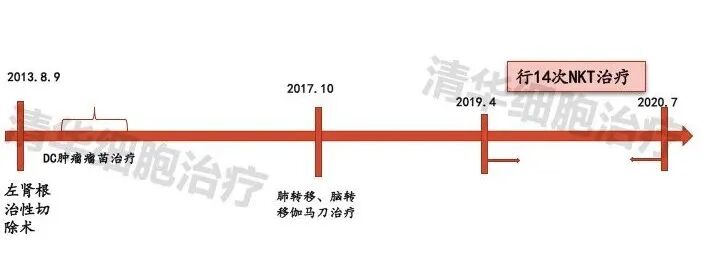
Mr. Chen discovered hematuria in March 2013, but without any pain. Upon visiting the hospital, a B-ultrasound revealed a giant mass lesion (6.6*5.4cm) in the upper pole of the left kidney, and a radical left nephrectomy was performed via abdomen. Postoperative pathology indicated grade ǁ clear cell carcinoma of the left kidney.

The treatment options for renal cancer are relatively limited. Surgery is the mainstay, and the disease is not sensitive to radiotherapy or chemotherapy. There are also few targeted drug options, so most patients with renal cancer feel quite conflicted.
Fortunately, immunotherapy has consistently shown promising results in treating kidney cancer.

Therefore, the patient chose autologous dendritic cell (DC) tumor vaccine therapy after surgery. And the effectiveness of immunotherapy was also proven - in the following four years, Mr. Chen's condition remained stable without any new developments.

However, in October 2017, PET-CT revealed multiple pulmonary metastases and brain metastases, prompting immediate local treatment with a gamma knife.
After a year and a half, in February 2019, a mediastinal metastatic tumor was found in the lungs, with a slight increase in size. However, cranial MRI did not reveal any abnormalities.
At this point, the choice of treatment method for patients becomes quite challenging - the signs of metastatic lesions becoming active again are quite evident. If chemotherapy or targeted drugs are used, they may suppress disease progression, but the side effects are significant, and the body damage is considerable, leading to internal resistance from patients. However, if milder methods are chosen, there is a concern that the momentum of disease progression may not be controlled.
After analysis by the Tsinghua cell therapy team, it was found that although Mr. Chen's medical history is simple, a pattern can still be observed:

The interval between the initial detection of the disease and the first occurrence of metastasis was four years, but only one and a half years separated the second detection of tumor reactivation.

This phenomenon is also observed in the occurrence and development of most tumors. After the first recurrence and metastasis, the time intervals between subsequent recurrences and metastases become increasingly shorter.

Therefore, NKT cell immunotherapy, which can both treat lung metastases and slow down the progression of the disease, achieving long-term stability with few side effects, is an ideal approach.
 

Conclusion


① After 14 consecutive courses of systemic treatment, 6 follow-up visits, and imaging examinations, Mr. Chen showed no significant signs of tumor progression.

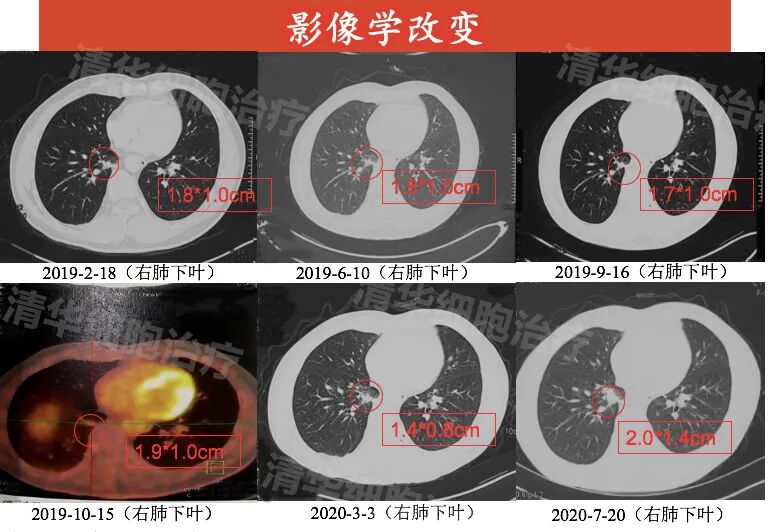
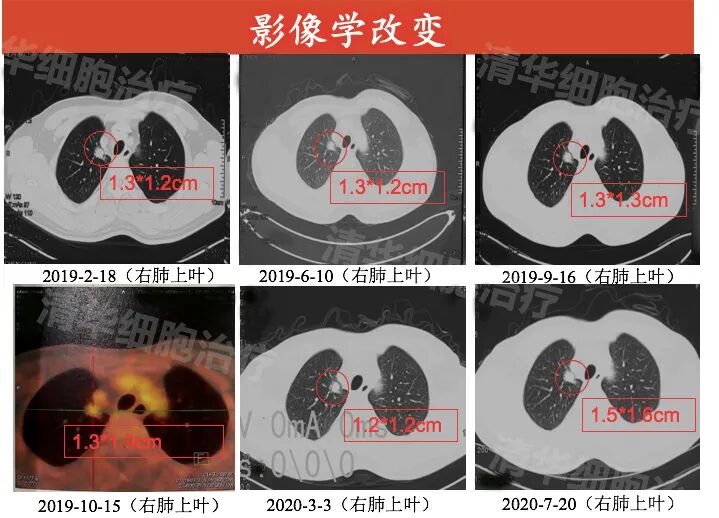
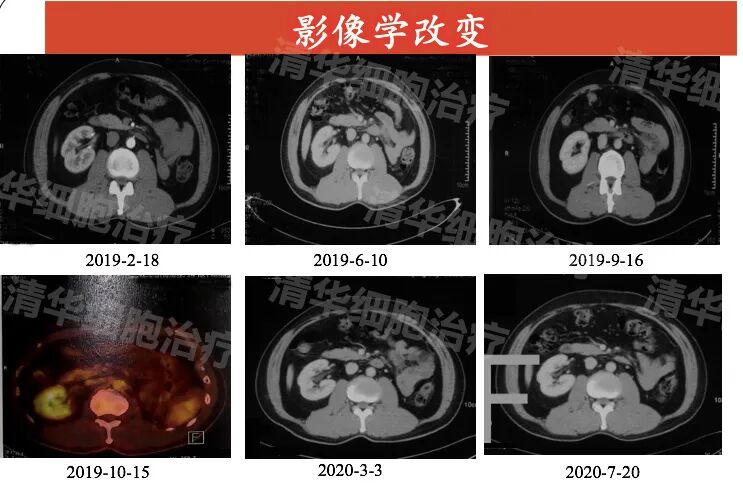
② The chest CT imaging review indicated no significant changes in the nodules in the right upper lobe from February 2019 to July 2020. The patchy increased density shadows in the right lower lobe showed no significant changes in size from February 2019 to July 2020. The PET-CT image from October 2019 showed slightly increased FDG uptake with an SUV value of 1.5, suggesting possible chronic inflammation, which should be observed carefully. Abdominal and pelvic CT examinations revealed no significant signs of recurrence or metastasis;
③ The patient's weight has increased by 2kg compared to before, physical strength and sleep have improved, skin allergies have decreased, and the quality of life is good.
④ Mr. Chen has been undergoing NKT therapy for nearly a year. Follow-up observations have shown that the early signs of tumor activity have been initially suppressed, and no new lesions have appeared. With the deepening of treatment, it is expected to remain stable.  


02

 Treatment Overview


In March 2013, the patient presented with intermittent, complete, painless gross hematuria. Upon visiting the People's Liberation Army Army General Hospital for an ultrasound examination, a huge mass lesion (6.6*5.4cm) was found in the upper pole of the left kidney. The patient then sought medical attention at the First Affiliated Hospital of China Medical University. On March 21, 2013, a transabdominal radical nephrectomy of the left kidney was performed. Postoperative pathology indicated: clear cell carcinoma of the left kidney, grade ǁ. After surgery, the patient underwent autologous DC tumor vaccine therapy.


On October 12, 2017


PET-CT reexamination: nodular shadows in the upper and lower lobes of the right lung, with increased metabolism, suggesting a high possibility of malignant metastasis. slightly high-density ring-shaped shadow in the right occipital lobe, suggesting possible metastasis. In October 2017, gamma knife radiotherapy was performed at the People's Liberation Army Army General Hospital for lung lesions and brain metastases.

February 20, 2019

Chest CT reexamination: Metastatic tumor in the mediastinum of the right upper lobe, with a slightly larger lesion compared to the previous examination.


On February 13, 2019,

cranial MRI showed no abnormalities. NKT cell immunotherapy was initiated on April 22, 2019, with a regimen of 4+4 courses/year. So far, 14 courses have been completed (as of July 2020).

03

 Imaging data

Lung imaging findings: Soft tissue nodules in the right upper lobe with no significant size changes from February 2019 to July 2020. The PET-CT image from October 2019 showed increased FDG uptake with an SUV value of 2.7, suggesting metastatic lesions, requiring close observation.

Lung imaging findings: Patchy increased density in the right lower lobe with no significant size changes from February 2019 to July 2020. The PET-CT image from October 2019 showed slightly increased FDG uptake with an SUV value of 1.5, possibly indicating chronic inflammation, requiring close observation.

Lower abdominal imaging findings: Absence of the left kidney observed from February 2019 to July 2020, with no significant enlargement of lymph nodes in the surgical area. The PET-CT image from October 2019 showed no increased uptake in the surgical area, requiring close observation.

Classic NKT Cases Review

Click on the image

to view

THE  END


Having read this far, please click "Watch" before leaving
上一篇:没有了