Contact Us Careers
Other Solid Tumors

After lung cancer surgery, brain metastasis occurred only six months later, and the method was used to contain it after two recurrences

时间:2026-04-27 人气:
Early-stage lung cancer, especially stage I lung cancer, does not require chemotherapy or radiotherapy after surgery as it has not metastasized to lymph nodes or distant sites
However, this does not mean that patients with stage I lung cancer can rest easy, as there are many cases of distant metastasis occurring within a year. The case presented in this article involves a patient who developed brain metastasis just six months after undergoing surgery for early-stage lung cancer. Compared to metastasis to other organs, brain metastasis is more malignant.
In addition to traditional radiotherapy and chemotherapy, cellular immunotherapy has also shown some effectiveness in controlling the progression of brain metastasis.
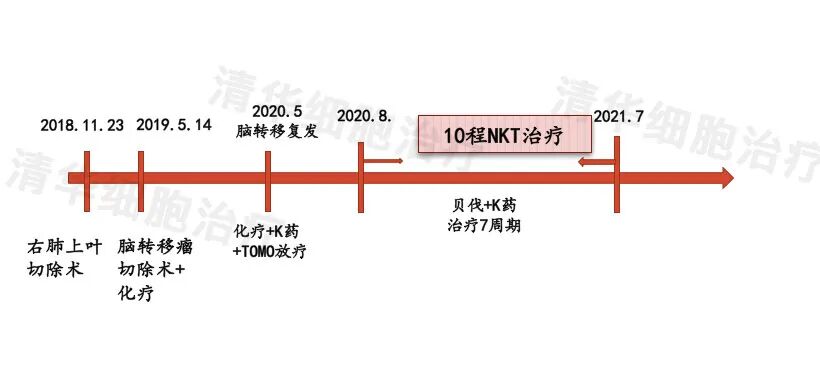
In November 2018, Mr. Zhang was found to have a high-metabolic nodule in the apex of his right lung during a physical examination, which was considered to be peripheral lung cancer and underwent surgical resection. The postoperative pathology revealed adenocarcinoma of the lung, with no involvement, lymph node metastasis, or EGFR mutation. The stage was pT1bN0M0, stage I, and no adjuvant chemotherapy was administered. Regular follow-up examinations were mainly conducted.
In May 2019, six months later, a follow-up MRI revealed a lesion in the left frontal lobe, leading to surgery for brain metastasis. Postoperative pathology confirmed brain metastasis. Subsequently, he underwent five cycles of pemetrexed plus carboplatin chemotherapy.
In May 2020, one year later, a follow-up MRI revealed another ring-enhancing lesion in the medial brain parenchyma. He underwent one cycle of bevacizumab plus paclitaxel liposomal formulation plus carboplatin, followed by 13 fractions of TOMO radiotherapy.
The two experiences of brain metastasis left Mr. Zhang with lingering concerns. He hoped that besides frequent chemotherapy, there could be a new method to slow down the progression of the tumor and delay the time of metastasis. The ideal outcome would be if there were no further recurrences or metastases.
>>>After learning about Mr. Zhang's medical history, the Tsinghua Cell Therapy Team analyzed and concluded that:

① For the existing brain metastases, due to the presence of the blood-brain barrier, NKT cells are relatively difficult to reach, making radiotherapy an ideal approach.

② However, for potential new lesions that may arise in the future, whether in the brain or other organs, NKT cell immunotherapy can play a preventive role.

In August 2020, Mr. Zhang underwent a course of NKT cell immunotherapy treatment once a month.

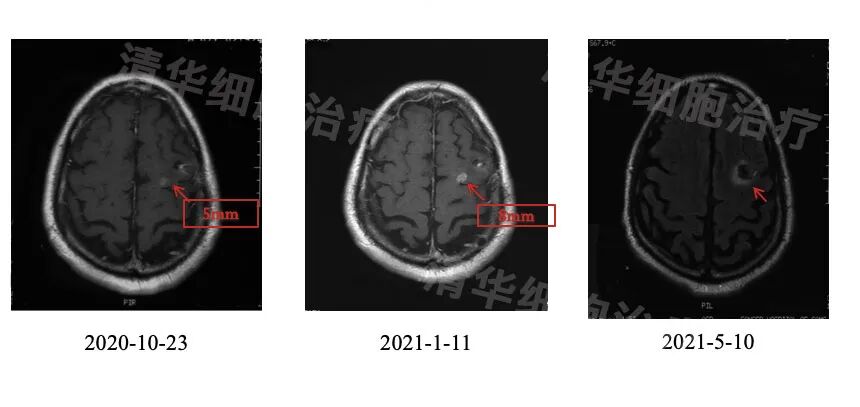
Brain MRI imaging findings: After radiotherapy for the metastatic lesion at the left frontal-parietal junction, the lesion measured approximately 5mm in size in October 2020 and 8mm in January 2021, slightly larger than before (the size of the 2020-5 lesion was approximately 1.1×1.0cm; no imaging images provided). In May 2021, a follow-up examination suggested a residual cavity in the center and a small amount of edema around the lesion, with no significant progression observed.

As of July 2021, Mr. Zhang had undergone a total of 10 courses of NKT cell immunotherapy treatment within a year. Upon re-examination of the cranial MRI, a slight edematous zone was observed around the metastatic lesion at the junction of the left frontal and parietal regions, likely due to radiotherapy. No significant progression was noted in the remaining

Chest CT showed no recurrence signs after right upper lung lobectomy; abdominal CT was generally normal; mental state, diet, and sleep were normal, with a good quality of life and a score of 76.5.

Classic NKT case review

Click on the image

to view