Contact Us Careers
Lung Cancer

How can lung cancer remain relapse-free and metastasis-free for 7 years? Read these 3 points of analysis and you'll know!

时间:2026-04-27 人气:


If you cannot understand the subsequent professional descriptions, you can finish reading this text in two minutes

Disease Overview


 
Mr. Wang is a senior friend who has been treating patients for over 7 years! We track and follow up on his cases annually and publish them (click to view past cases1. [Case presentation of synchronous dual primary lung cancer treated with NKT therapy]2. (Anti-cancer Heroes | No.1 May the River of Life Flow Endlessly
Eight years ago, Mr. Wang's younger brother was diagnosed with lung cancer. Despite undergoing surgery and chemotherapy, he passed away after a year, leaving behind his loved ones. Mr. Wang was devastated. After handling his brother's funeral, he felt physically and mentally exhausted and worried about having a genetic predisposition, so he went to the hospital for a physical examination. However, fate did not grant him a single bit of luck - Mr. Wang was also diagnosed with lung cancer!!  
And the malignancy was even higher than his brother's! It was multicentric invasive adenocarcinoma! The double blow plunged the entire family into a state of sorrow and gloom. In August 2014, after being diagnosed with lung cancer, Mr. Wang underwent immediate surgical treatment. Postoperative pathology revealed: invasive adenocarcinoma, predominantly alveolar type, moderately differentiated, positive for vascular invasion, and positive for pleural infiltration; (right upper lung) invasive adenocarcinoma, predominantly papillary type, poorly differentiated.

Section

Pu

Small    
Knowledge

What is "multicentric origin" of invasive adenocarcinoma?

 
Although the tumors in Mr. Wang's right upper lung and pleura were both adenocarcinoma in postoperative pathology, the two nodules had different properties, suggesting the possibility of dual primary cancers - that is, having two types of cancer simultaneously, which is a very rare condition. The tumor in the pleura was poorly differentiated adenocarcinoma, indicating a potentially poor prognosis. The degree of differentiation in pathological classification reflects the malignancy of the tumor. Canceration of normal cells generally occurs during the transformation from stem cells to normal cells. The lower the degree of differentiation, the closer the tumor cells are to stem cells and the greater the difference from normal cells, with stronger proliferative capacity, mutation ability, self-repair ability, and resistance to chemotherapy and radiotherapy. Conversely, high differentiation indicates that the tumor cells are more similar to normal cells, which means the malignancy of the tumor is relatively low and the possibility of metastasis is relatively small.  
However, patients with lung adenocarcinoma have one more treatment option compared to those with lung squamous cell carcinoma - targeted therapy. After surgery, Mr. Wang did not undergo chemotherapy, but after genetic testing, it was found that he had EGFR mutations, and he was treated with gefitinib, a targeted drug, for four months.
Despite undergoing timely surgical treatment and targeted therapy, Mr. Wang still felt uneasy. The pathology report mentioned vascular invasion. Vascular invasion is a high-risk factor. Usually, tumors grow by infiltrating deep into the tissue, and the invasion of deep vessels by tumors indicates that cancer cells have entered the vascular network. Tumor cells precisely use this method to leave the primary lesion and metastasize to other sites, thus posing a higher risk of recurrence in the future.
Mr. Wang remained uneasy. After learning from various sources, Mr. Wang and his family, recommended by friends, learned about Professor Zhang Minghui's NKT technology at Tsinghua University School of Medicine, and carefully reviewed the displayed cases of NKT cell therapy. They particularly hoped to try it to reduce the risk of tumor recurrence and delay the occurrence of recurrence/metastasis.
After reviewing Mr. Wang's medical records, Professor Zhang Minghui made the following analysis and judgment:
1. The patient underwent radical surgery at an early stage of tumor development, and the postoperative staging was relatively early. Taking targeted drugs for four months after surgery had a very positive effect on prognosis, but targeted drugs have the disadvantage of resistance, which cannot completely eliminate the risk of recurrence and metastasis.  
2. Although an early postoperative staging is generally considered good news, the vascular invasion and differentiation type indicated by the pathological results still suggest a significant risk of recurrence and metastasis. Even if there is currently no tumor detectable by imaging examination, it cannot be guaranteed that recurrence and metastasis will not occur again. To consolidate the early "achievements," another effective treatment method - cellular immunotherapy - needs to be sought.  
3. NKT therapy utilizes powerful immune cells to eliminate tumor cells that may remain undetected in the body, with essentially no side effects, making it very patient-friendly. After completing conventional treatment, NKT cell therapy is used to maintain long-term systemic stability.
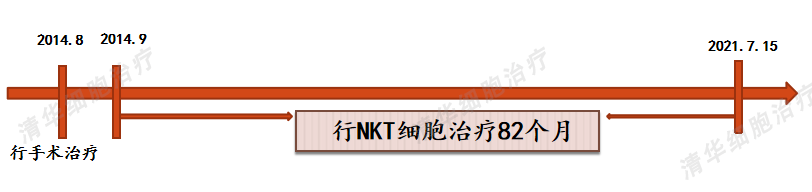
Mr. Wang decided to undergo NKT cell immunotherapy in September 2014. The initial plan was one course per month. After multiple follow-up examinations, no signs of recurrence or metastasis were observed, and the treatment frequency was reduced to one course every two months. After six consecutive follow-up assessments with no signs of recurrence or metastasis, the treatment frequency has been adjusted to one course every six months.
As of July 2021, a total of 32 courses have been completed, covering a total of 82 months.

Image aspect


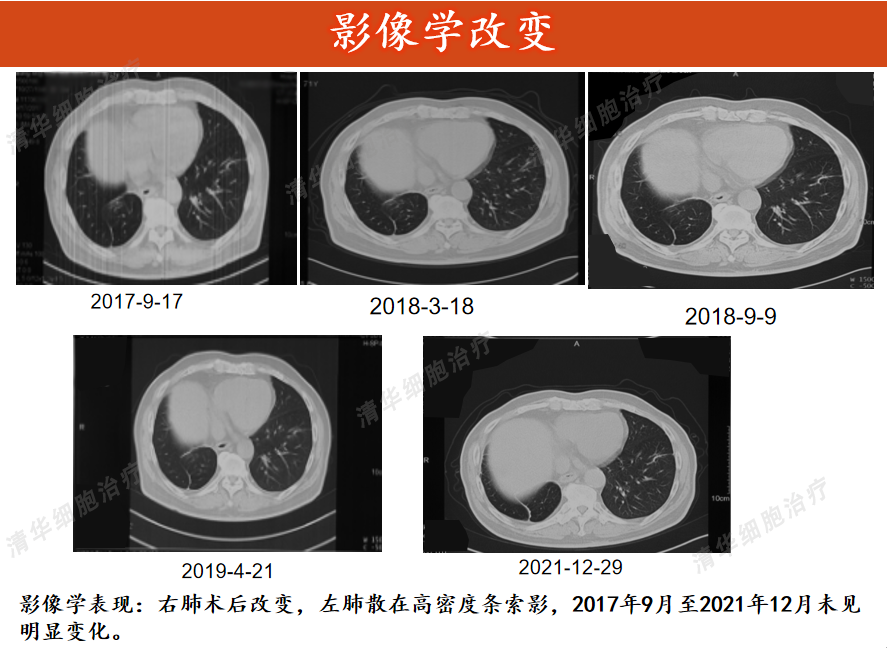
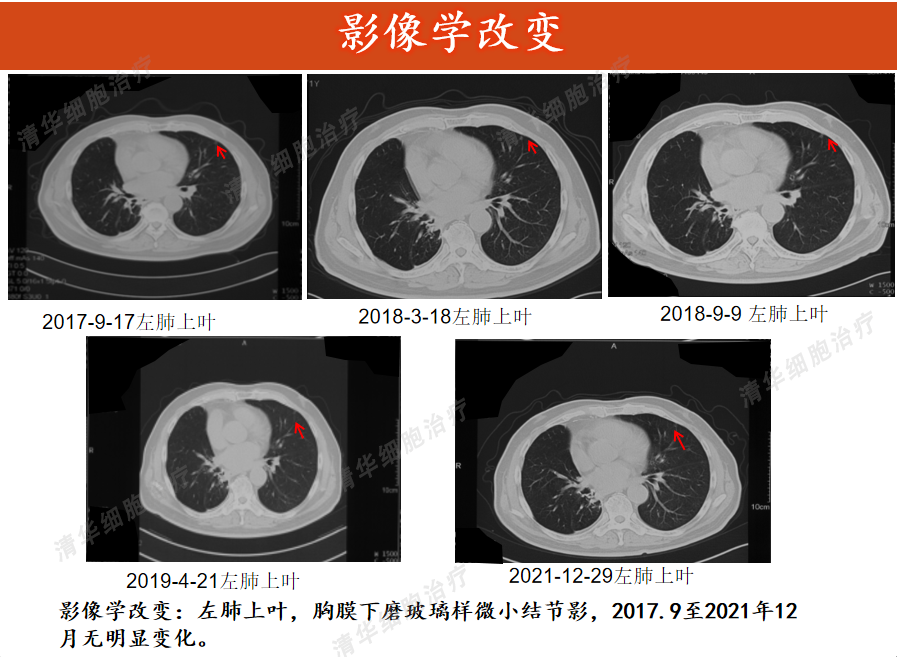
No significant changes were observed from September 2017 to December 2021;A ground-glass opacification micronodule shadow is present in the left upper lobe, with no significant changes observed from November 2014 to December 2021.A ground-glass opacification micronodule shadow is present near the pleura in the left lower lobe, with no significant changes observed from November 2014 to December 2021. Overall, the evaluation is stable.
 

Tumor markers


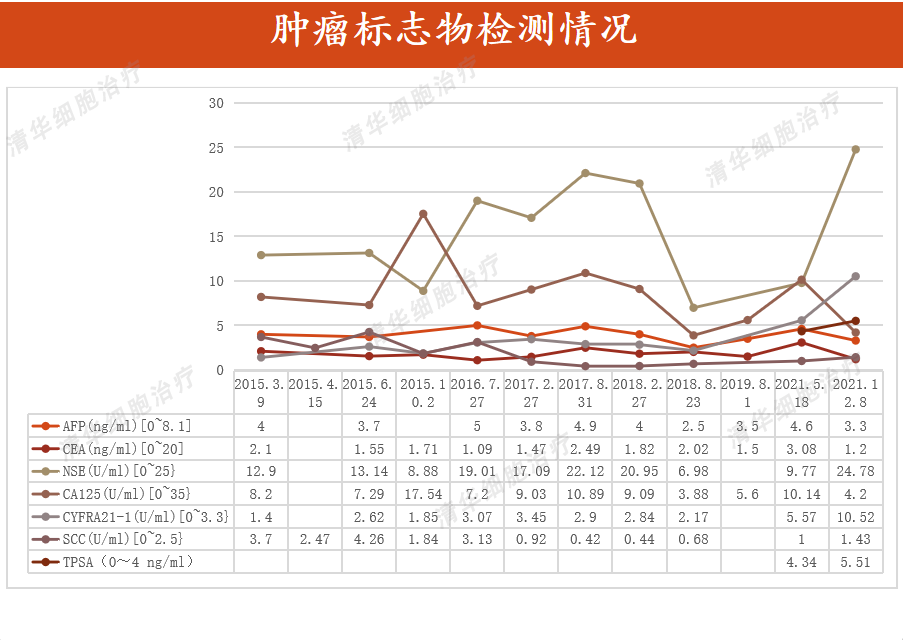
CYFRA21-1 was slightly higher than normal on February 27, 2017, while the rest were within the normal range; SCC increased intermittently from March 2015 to July 2016. On May 18, 2021, and December 8, 2021, CYFRA21-1 and TPSA were higher than normal. On December 8, 2021, NSE was higher than normal.


Quality of Life


Mr. Wang's quality of life has been greatly improved. His appetite has improved significantly compared to before treatment, and his mental state is very good, returning to the state before he got sick. He can work and live normally, and his daily life has not been affected by the disease.


Conclusion   Discussion

Mr. Wang's situation is actually quite common. Many patients believe that surgery can provide a permanent cure, ignoring the high risk of recurrence due to poor pathological staging and vascular invasion. NKT cell immunotherapy plays an indispensable role in reducing the risk of recurrence and metastasis. It not only eliminates residual tumor cells but also strengthens the immune system. Over 82 months, with 32 courses of treatment that underwent continuous changes and adjustments, Mr. Wang's multiple follow-up evaluations showed stable disease, and his overall mental and physical well-being improved systematically.

Popular science knowledge is provided for reference only. Individual patients should seek clinical medical advice.                    

NKT classic case review

Click on the image

to view