About Lehe
乐于心,和与众,与己乐,与人和; 心宽念纯,百病无生。


乐于心,和与众,与己乐,与人和; 心宽念纯,百病无生。


If you cannot understand the subsequent professional descriptions, you can finish reading this text in two minutes.
Overview of the disease
knowledge
Robot-assisted Pancreatoduodenectomy (RPD)
Pancreatoduodenectomy is a complex and challenging surgery. Early minimally invasive pancreatoduodenectomy failed to successfully transition into a commonstandard surgical approach. In 2001, the Guilianotti team completed the first RPD, and in 2003, they published a clinical study on 8 cases of RPD, demonstrating the safety and feasibility of RPD. The advantage of robotic surgical systems in pancreatoduodenectomy lies in the stability and precision of local anatomy. Due to the magnified surgical field and stable manipulation, for some resectable tumors with vascular invasion at the junction, it is possible to easily perform intravascular and extravascular dissection to achieve the required anatomical level, achieving R0 resection of the tumor, and even combined vascular resection and reconstruction, greatly improving the radical resection rate of malignant tumors. At the same time, robotic surgical systems are more adept at handling arterial or venous bleeding, enabling rapid hemostasis and thus significantly reducing the rate of conversion to open surgery. RPD has significant advantages in terms of operation time, intraoperative blood loss, and hospital stay, while also improving patient survival rates. It is an effective treatment method.
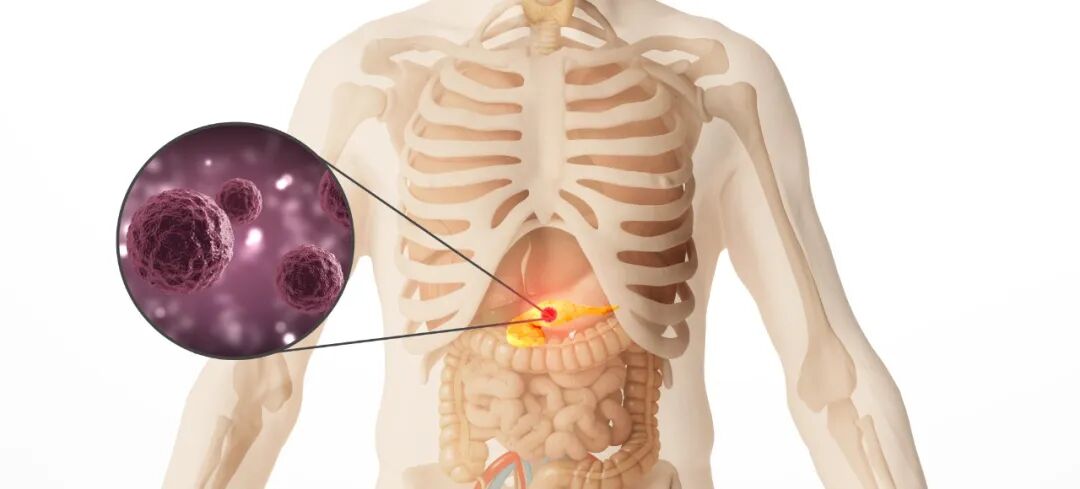
2. Pancreatic cancer is a type of gastrointestinal tumor with extremely poor prognosis. Pathological examination of patients reveals the presence of surrounding soft tissue and nerve invasion, indicating a high risk of postoperative recurrence.
3. vNKT therapy utilizes powerful immune cells to eliminate tumor cells that may remain undetected in the body, with essentially no side effects. On the basis of conventional treatment, vNKT therapy can effectively reduce the risk of tumor recurrence and delay the occurrence of recurrence/metastasis.
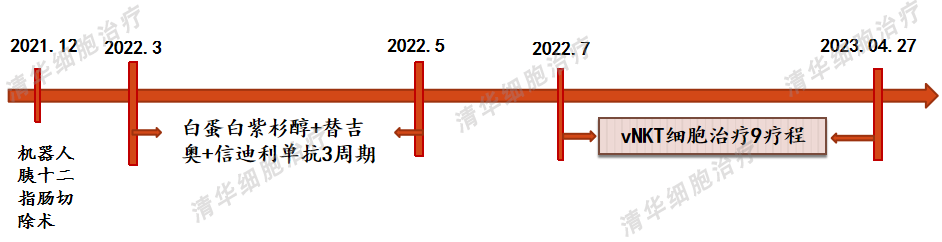
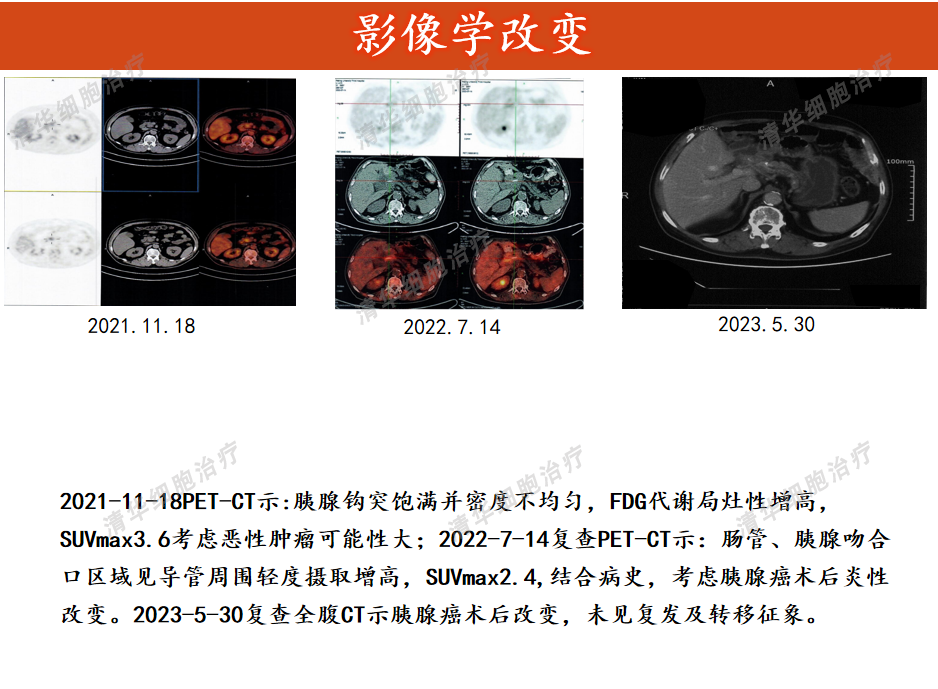
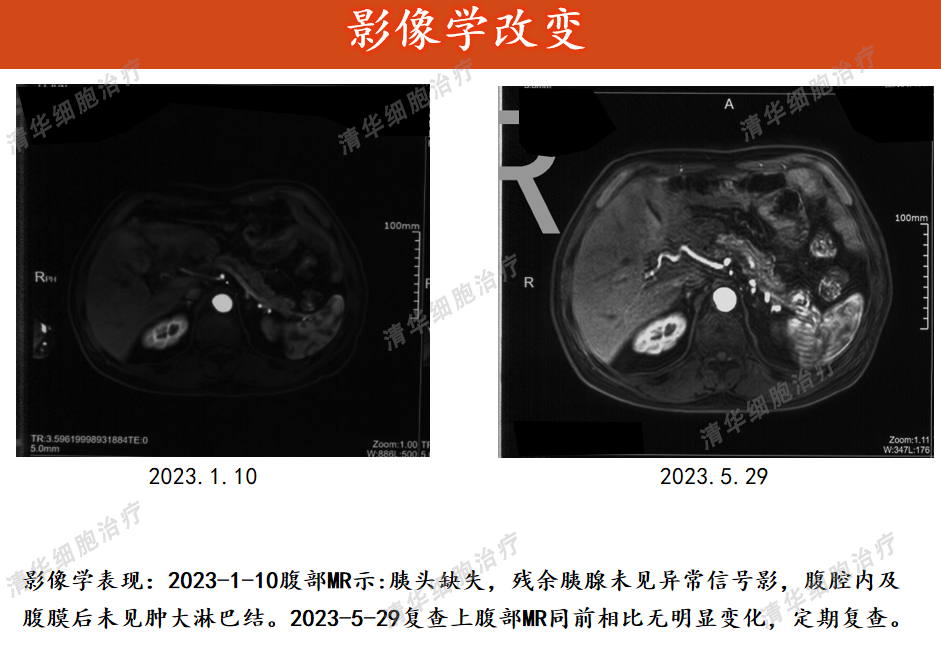
Image aspect
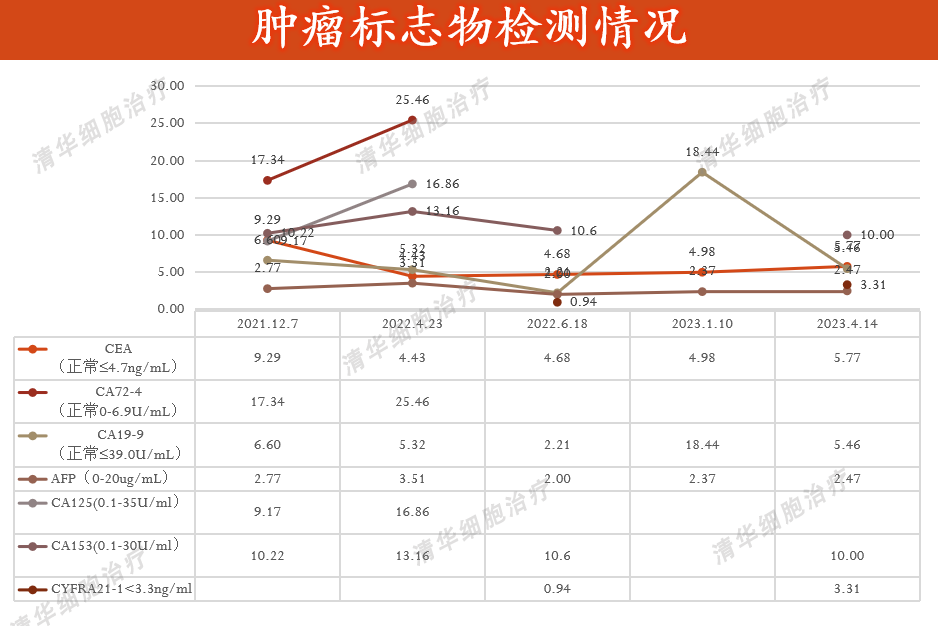
Tumor markers
CEA: Above normal in December 2021, returned to normal range after reexamination from April 2022 to January 2023, and exceeded normal range again in April 2023. Monitor closely.
CA724: Showed an increasing trend from December 7, 2021, to April 23, 2022. Not tested for this indicator after June 2022. Pay attention to reexamination.
CYFRA21-1: Within normal range during reexamination in June 2022, but exceeded normal range in April 2023. Pay attention to reexamination.
The remaining indicators, CA199, AFP, CA125, and CA153, were within normal range from December 2021 to April 2023.
Conclusion and Comments
Reference:< H351>
【1】Lee, Mirang, Wooil Kwon, Hongbeom Kim, Yoonhyeong Byun, Youngmin Han, Jae Seung Kang, Yoo Jin Choi, and Jin-Young Jang. 2020. "The Role of Location of Tumor in the Prognosis of the Pancreatic Cancer" Cancers 12, no. 8: 2036.
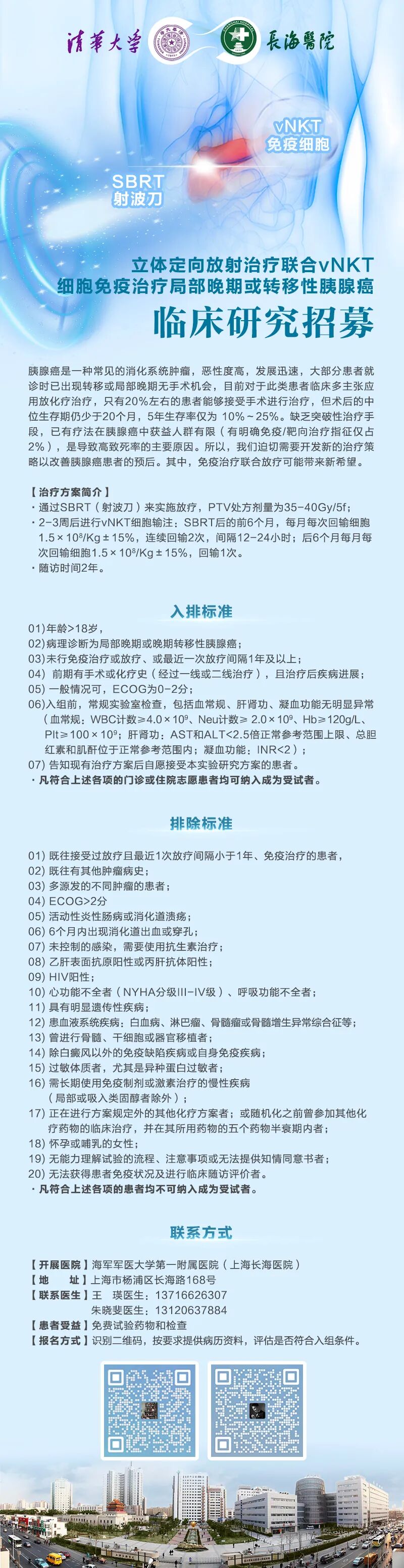
【 Recruitment of patients] Clinical study of locally advanced or metastatic pancreatic cancer< H370>
Click on the image
Address: Room 1101 (Unit 101), 11th Floor, Building 1, No. 7 Courtyard, Kexueyuan Road, Life Science Park, Changping District, Beijing
Phone:010-8265 9866
Email:lehemedneo@hotmail.com