Contact Us Careers
Breast Cancer

Immunotherapy: The Last Line of Defense for Breast Cancer with Bone Metastasis!

时间:2026-04-16 人气:
           
点击蓝字  关注我们            


# 乳腺癌              

             
中国女性最常见的恶性肿瘤之一,被称为“粉红杀手”,其发病率位列女性恶性肿瘤之首,发病率逐年上升且有年轻化趋势。我国现患乳腺癌患者数量已达到100多万,1年新发乳腺癌30多万,也意味着30多万个家庭要饱受癌症的折磨。


在所有的恶性肿瘤中,乳腺癌属于治疗效果相对较好的癌种,根据国家癌症中心的最新数据,我国乳腺癌的总体五年生存率已经达到83%,但对于不同分期阶段的乳腺癌患者,五年生存率仍存在显著差异,Ⅰ期:94%,Ⅱ期:84%,Ⅲ期:65%,Ⅳ期:21%。由此可见对于晚期乳腺癌患者目前的治疗效果仍不尽人意。
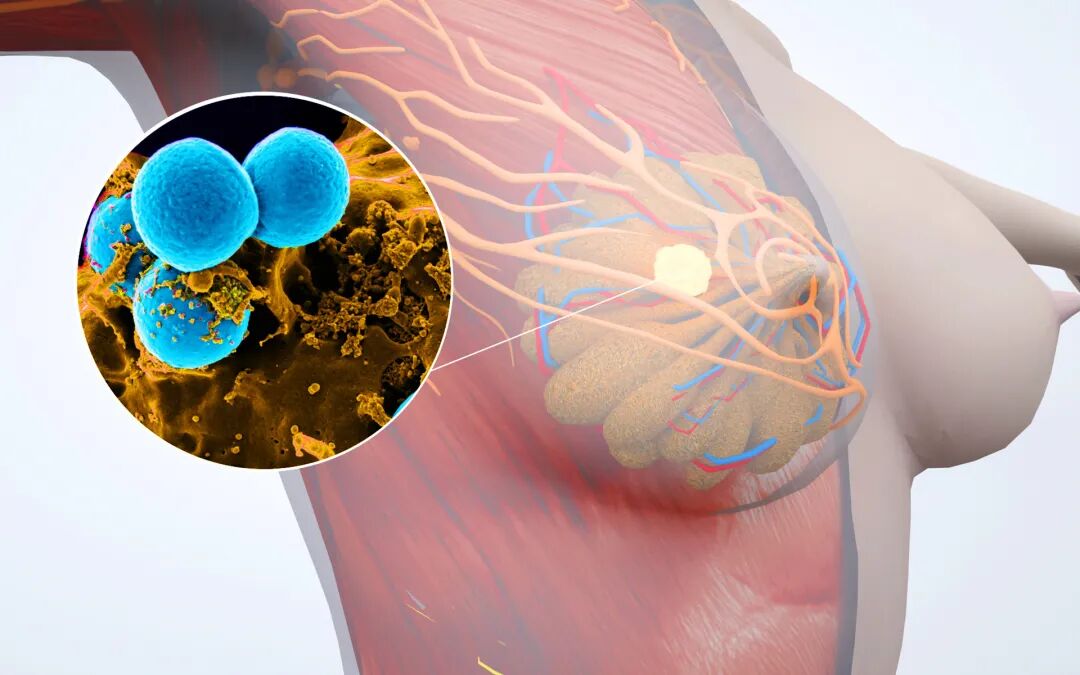

     
这些晚期乳腺癌患者往往发现时已存在骨转移、肝转移、肺转移等器官转移。多数情况这些患者已经失去手术机会,无法获得根治性治疗,只能依靠化疗或靶向治疗在一定程度上延缓病情的进展,有些患者在经过药物治疗后有幸获得手术机会,但由于一些潜伏的肿瘤细胞无法被彻底清除,复发往往也是无法避免的。      


那么,在科学快速发展的今天,有没有一种方法能让晚期乳腺癌患者也获得良好的治疗效果呢?魏女士的治疗过程或许会给到我们一些启发。


01              


情概述              

Overview of the illness


魏女士于2020年发现左乳包块,于2021-8-02行左乳穿刺活检示浸润性导管癌。      

     
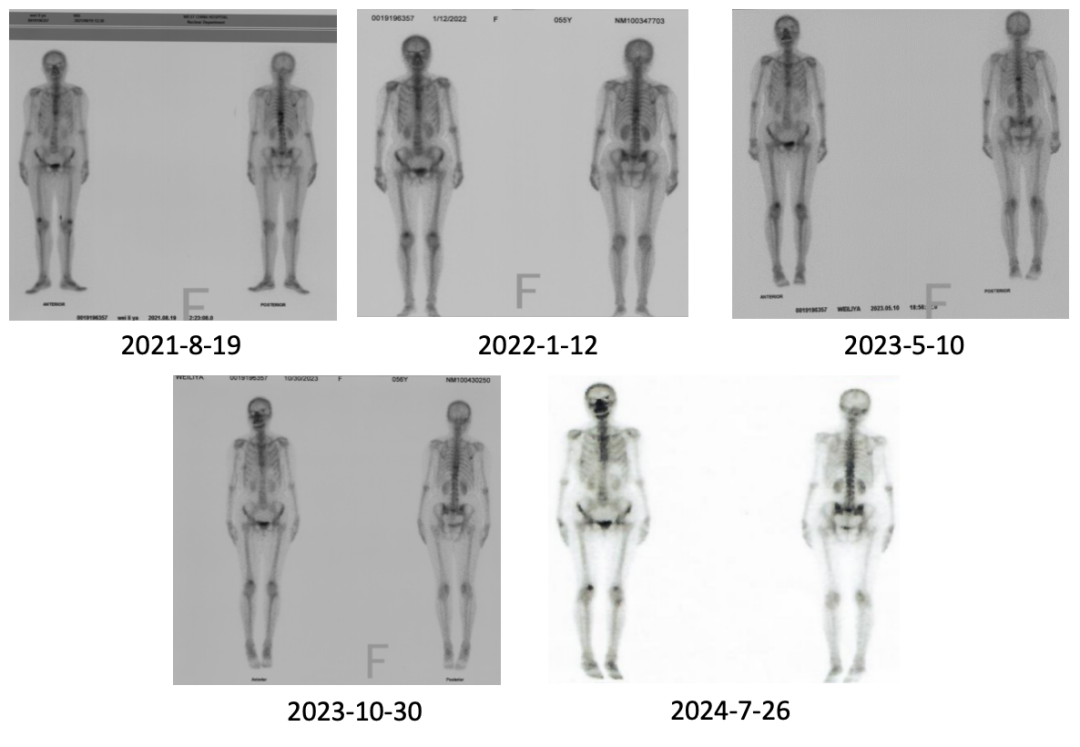
2021-8-19 SPECT全身骨显像示:1、右侧第六肋腋段、T9椎体代谢增高灶,考虑肿瘤骨转移。2.T10-12椎体骨代谢增高灶,肿瘤骨转移不除外。于2021-8-26至2022-3完成8周期(表柔比星+环磷酰胺续贯多西他赛)方案化疗。      

     
2022-4-14行根治性手术治疗。术后病理:浸润性乳腺癌(非特殊型),组织学分级2级,最大径2cm,手术切缘阴性,淋巴血管侵犯(LVI),有乳头受累,无皮肤受累,淋巴结,“左腋窝淋巴结1-2水平” (6/6) 枚查见癌转移,余脂肪组织内见癌浸润。左锁骨下淋巴结”及尾叶结节为纤维脂肪组织查见癌浸润。ER (强+,>90%)、PR (强+,70%)、HER2 (2+)、CK5/6 (-)、Ki-67 (+,20%)。术后2022-6-18至2023-2服用卡培他滨8周期(放疗期间停止),2022-8-8至2022-9-9放疗25次。自2022-5开始服用来曲唑内分泌治疗至今。      

     
2023-2开始服用阿贝西利至今。2023-5-10骨显像示:胸腰部分椎体骨代谢增高灶,肿瘤转移可能,对比2022.01.12骨显像,T9椎体骨代谢程度稍增加。      


由于初诊时即为Ⅳ期乳腺癌,经过化疗后获得手术切除机会,但术后病理提示多种复发高危因素,且在治疗后的复查中腰椎病灶仍有活性可能,所以魏女士及家人甚为担忧出现病情进展。故多方求医,欲寻找能够长期控制肿瘤的治疗手段。后来一个偶然的机会魏女士家人了解到清华大学医学院张明徽教授的vNKT细胞治疗技术,参考了既往的治疗案例,对此治疗技术产生极大兴趣,后与我们取得联系。


张明徽教授在看完魏女士的病历资料后,做出了乐和新医第二诊疗建议:      

     
1. 魏女士乳腺癌发现时即为晚期,经过术前化疗、手术、术后放化疗及内分泌治疗后肿瘤得到基本控制,可测病灶消失,这为获得后续治疗创造了有利条件。      

     
2. 术后病理提示浸润性乳腺癌(非特殊型),组织学分级2级,最大径2cm,手术切缘阴性,淋巴血管侵犯(LVI),有乳头受累,无皮肤受累,淋巴结:“左腋窝淋巴结1-2水平” (6/6) 枚查见癌转移,余脂肪组织内见癌浸润。左锁骨下淋巴结”及尾叶结节为纤维脂肪组织查见癌浸润。根据以上病理结果,存在多种术后复发高危因素,即使在进行了根治性手术及术后放化疗、内分泌治疗的情况下,仍不能完全排除存在微小残留病灶可能,存在极高的复发几率。      

     
3. vNKT治疗可利用强大的免疫细胞杀灭那些可能残存在体内无法被发现的肿瘤细胞,并且可以重建免疫微环境,且基本没有副作用。在完成常规治疗的基础上,vNKT治疗可以有效的降低肿瘤复发风险,甚至获得临床治愈机会,非常适合作为魏女士后续治疗的主要治疗手段。      


vNKT细胞免疫治疗            


NKT细胞 (Natural killer T cell),            
是一种细胞表面既有T细胞受体TCR,又有NK细胞受体的特殊T细胞亚群,它兼具NK细胞和T细胞的重要特征,具有非特异性和特异性识别肿瘤细胞的双重能力,可以非常快速地杀伤肿瘤细胞。在NKT细胞亚群中,有一种个头更大、杀伤能力更强的特种兵,就是清华大学张明徽教授的实验团队发现的vNKT(Variant  Natural Killer T)细胞。            

           
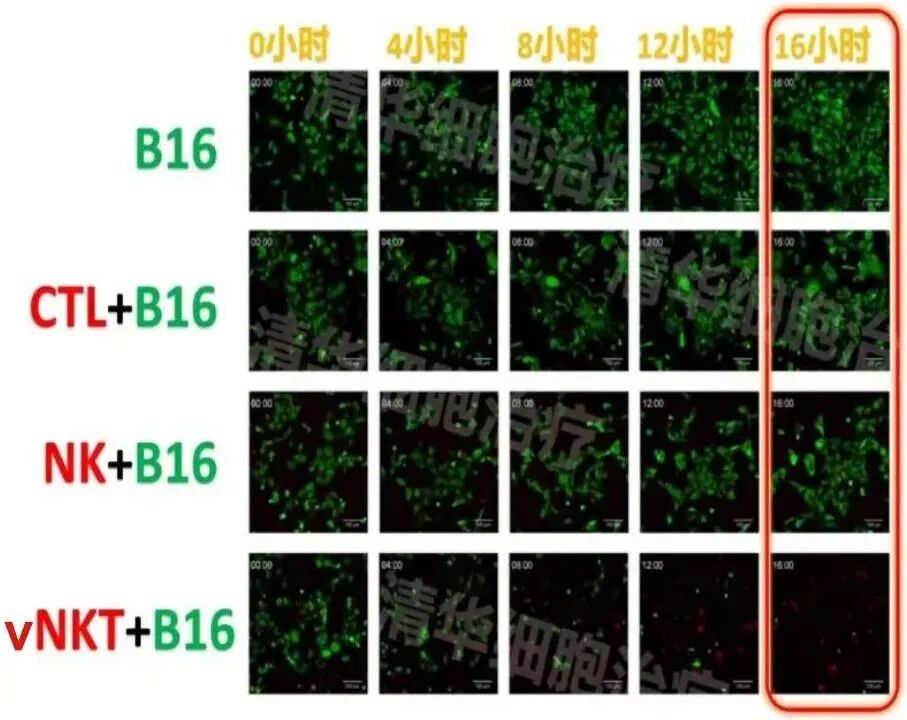
这群vNKT细胞在体内的数量非常少,且不会轻易被激活。但是一旦被活化,却能以一当百,杀灭那些可能残存在体内无法被发现的肿瘤细胞。另外,研究还发现vNKT细胞具有双重抗肿瘤效应,不仅能够直接杀伤癌细胞,还会调节肿瘤组织内部的免疫微环境,杀伤抑制性免疫细胞MDSCs,打破肿瘤的免疫逃逸,重建正常免疫系统,进一步预防复发转移。            


Experimental conditions: In the presence of vNKT cells, after 16 hours, nearly all B16 tumor cells were killed!


Professor Zhang introduced in detail the vNKT treatment technology and the treatment outcomes of previous cases to Ms. Wei and her family, and provided detailed answers to Ms. Wei's questions. After thorough communication, Ms. Wei and her family finally agreed, and the vNKT cell treatment was initiated on July 5, 2023. The treatment plan was 1 course/month, and a total of 12 courses were completed by July 5, 2024. Currently, the patient's condition is stable during follow-up, and the patient is in good spirits, with good appetite and sleep, and a good quality of life.      


02            


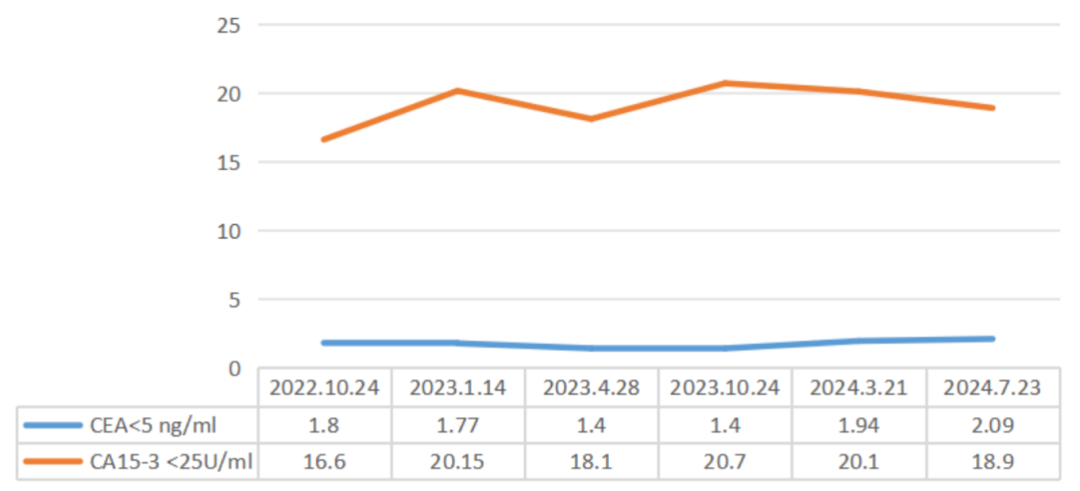
Changes in tumor markers 

Tumor markers            


03                


Imaging changes 

Imaging  changes                

Bone scans showed the following on August 19, 2021: 1. Metabolic enhancement in the right 6th costovertebral segment and T9 vertebral body, suggesting tumor bone metastasis; 2. Metabolic enhancement in T10-12 vertebral bodies, with bone metastasis not excluded. On January 12, 2022, scans showed punctate and patchy increased radioactive concentration in T9-T12 vertebral bodies. On May 10, 2023, scans revealed metabolic enhancement in some thoracolumbar vertebral bodies, suggesting possible tumor metastasis. Compared to the bone imaging on January 12, 2022, the metabolic level of T9 vertebral body slightly increased. On October 30, 2023, scans showed metabolic enhancement in T9 vertebral body with reduced density. On July 26, 2024, scans indicated the following: 1. Metabolic enhancement in some thoracolumbar and sacral vertebral bodies, as well as in the lower part of the right scapula, suggesting changes after tumor bone metastasis treatment, with no significant change compared to previous bone metabolic levels. 2. Metabolic enhancement in the right 6th posterior costovertebral segment near the axillary region, likely due to changes after treatment.
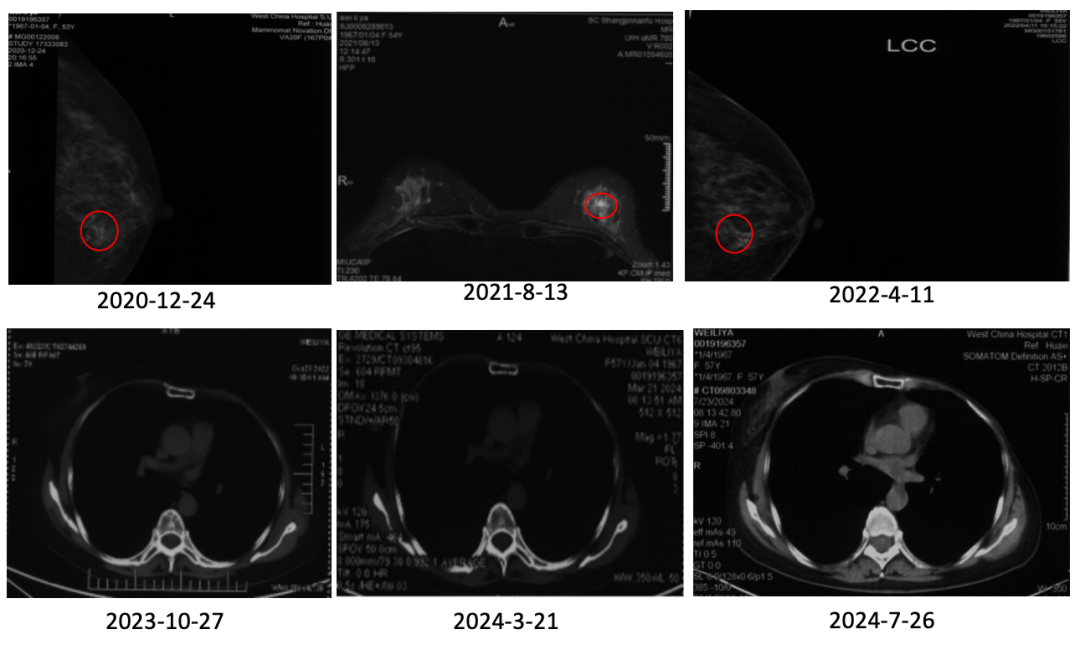


Chest CT showed a solid mass at 10 o'clock position in the upper outer quadrant of the left breast on December 24, 2020, as well as on August 13, 2022, and April 11, 2022, respectively, as indicated by mammography and breast MRI. Follow-up lung CT scans in October 2023 and July 2024 revealed postoperative changes in the left breast, with no signs of recurrence in the surgical area.      


04            


Conclusion and Comments

Conclusion and Commentary


Most cancer patients who are diagnosed with advanced-stage disease tend to be pessimistic and disappointed, believing that there is no cure and they can only await their deaths. However, in today's era, with the rapid development of science, the concepts and technological levels of cancer treatment are also changing rapidly. Cases that were previously considered untreatable often achieve unexpected treatment outcomes through the implementation of scientific concepts of comprehensive cancer treatment and the use of advanced treatment technologies.      

     
In this case, Ms. Wei was diagnosed with stage IV breast cancer at the initial consultation. After undergoing preoperative chemotherapy, surgery, postoperative chemoradiotherapy, and endocrine therapy, her tumor was basically controlled, and measurable lesions disappeared. Instead of passively waiting for tumor recurrence or metastasis, Ms. Wei scientifically evaluated prognostic factors and believed that the risk of tumor recurrence and metastasis was high. Therefore, she actively sought effective follow-up treatment options and ultimately chose vNKT cell therapy. So far, she has been in stable condition for 3 years, achieving ideal therapeutic effects. In this process, vNKT cell immunotherapy played an indispensable role in reducing the risk of recurrence and metastasis, providing patients with the possibility of long-term tumor stability or even cure.      


Since the discovery of vNKT cells in 2002, Professor Zhang Minghui's research team has embarked on a research journey spanning over 20 years, accumulating treatment experience from over 700 cases of solid tumors, covering almost all common solid tumors. The research results fully demonstrate the immense value of vNKT in the treatment of solid tumors, making it suitable for postoperative patients with high pathological malignancy or a risk of recurrence; patients who require conventional chemoradiotherapy but cannot tolerate it; patients whose tumors have been basically controlled but not cured after conventional treatments such as chemotherapy, radiotherapy, and targeted therapy; and patients with persistent high carcinogenic factors. If these patients do not receive effective follow-up treatment after traditional anti-tumor therapy, recurrence, metastasis, or reoccurrence of tumors will be highly probable. In this case, vNKT cell therapy is an ideal follow-up treatment method, which can significantly improve the prognosis of patients.



Lian
is a
I
         
Scan QR code
Communication with Professor Zhang Minghui's team


Click on the image to view the exciting content from previous issues


Contributed by: Liu Peng
Reviewed by: Qiao Jiacheng, Wang Ying, Gao Chen
Edited/typeset by Zhang Jiao


Reposting is a driving force, sharing is a virtue